
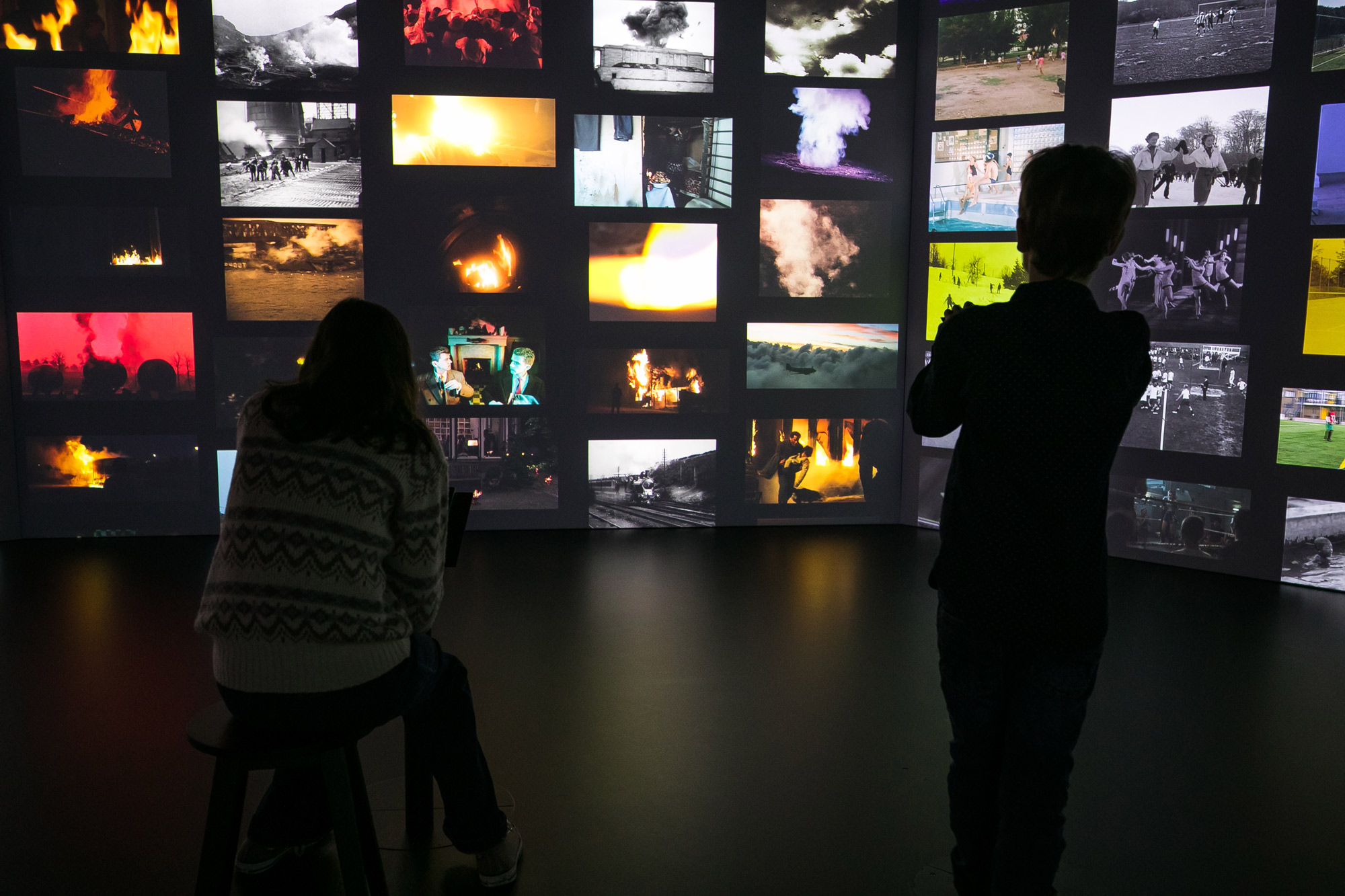

Users interacting with the Film Catcher installation at the Eye filmmuseum.
Image: Jordi Wallenburg.
Archival Landscapes of AI
Archival Landscapes of AI promotes environmental sustainability through archival practices, exploring how AI relates to historical narratives and environmental histories.
Informatics Institute & Media Studies at the University of Amsterdam, supported by cultural partner EYE Filmmuseum.

AI techniques for audiovisual archive accessibility have advanced significantly since the early 2000s, particularly through Deep Learning developments in the 2010s. These technologies enable content-based search by algorithmically extracting information from visual materials. However, more capable AI approaches carry substantial environmental costs, creating tension between accessibility goals and sustainability concerns.
This project addresses the ethical questions surrounding trade-offs between archival accessibility and environmental impact. Rather than focusing solely on reducing AI’s environmental footprint, we examine how audiovisual archives can serve dual roles: as users of environmentally costly AI technology and as platforms for raising awareness about these impacts through their connection between artistic expression and society.
Our central research question is: How can AI reconfigure and reactivate audiovisual archives in sustainable ways?
We develop AI approaches that create sustainability-related data enrichments, allowing us to examine archives’ potential for communicating AI’s environmental costs while simultaneously improving accessibility and enabling new forms of interaction through moving image art installations. By engaging users through artistic installations, we reimagine archival access and experiment with artistic expression that uses collections and data enrichments to encourage discussion and reflection.
The project centers on Eye’s Film Catcher installation to investigate methods for creating sustainability-based image category enrichments and utilizing these within moving image art installations. We critically reflect on proposed methods, their epistemology, and how art installations can leverage AI to break through existing patterns.
Ultimately, this research explores how new forms of knowledge production can emerge from reconfiguring user interactions with audiovisual collections through moving image art installations, grounded in sustainability-focused data enrichments of archival material.
Project Team
Selina Khan is a research assistant and MSc. graduate in Artificial Intelligence at the University of Amsterdam, researching the intersection of AI and Visual Arts. Her research interests include the challenges of capturing nuanced, context-rich information from the artistic domain in AI systems and exploring how such technologies can deepen our understanding of art, while respecting the inherent subjectivity and cultural significance of artistic expression.
Nanne van Noord is Assistant Professor at the Multimedia Analytics lab of the University of Amsterdam. His research lies at the intersection of Computer Vision and Visual Culture, with the aim of integrating visual cultural understanding into AI models to bridge the gap between humanistic and algorithmic inquiry.
Christian Gosvig Olesen is Assistant Professor of Digital Media and Cultural Heritage at the Department of Media Studies at the University of Amsterdam. He teaches in the university’s MA programs in Film Studies and Preservation and Presentation of the Moving Image. He is the author of Visualizing Film History: Film Archives and Digital Scholarship (Indiana University Press, 2025).
Irene Haan is project manager Museum Collection Presentations at Eye Filmmuseum in the Netherlands. She develops presentations that provide access to Eye’s digital film collection – both in the museum (on site) and online – and uses new technologies that facilitate making the collection accessible to visitors. Irene’s contributions include interactive museum installations, a streaming platform, museum tours, audio stories, a film history database, and film heritage reuse projects.
By cross-pollinating artistic and scientific research, the AI2– Artistic Inquiry x Artificial Intelligence consortium aims to provide holistic perspectives on AI technologies, that include human and more-than-human experience, ethical considerations, and planetary awareness towards more just futures.
This project in the research programme Innovation and Networks is (partly) financed by the Dutch Research Council (NWO) under the grants:
Archival Landscapes of AI (NWA.1418.24.008)
AI Greenhouse (NWA.1418.24.013)
Slow AI (NWA.1418.24.036)