Archival Landscapes of AI: User Requirements Workshop
THE PROJECT
On December 4, 2025, the Archival Landscapes of AI project (2025–2027) held a user requirements workshop at the Eye Collection Centre in Amsterdam. The research project centres around the tension between the potential of Artificial Intelligence to improve accessibility of audiovisual archival collections, as well as the environmental impact of AI applications in archival contexts. The implementation of artificial intelligence has enabled the automatic extraction of information from visual content, resulting in more descriptive metadata that can be searched. Artificial Intelligence, however, is entangled with histories of extraction and ecological destruction. The vast amounts of resources that AI requires means that these automatic ‘data enrichments’ come with an environmental cost.
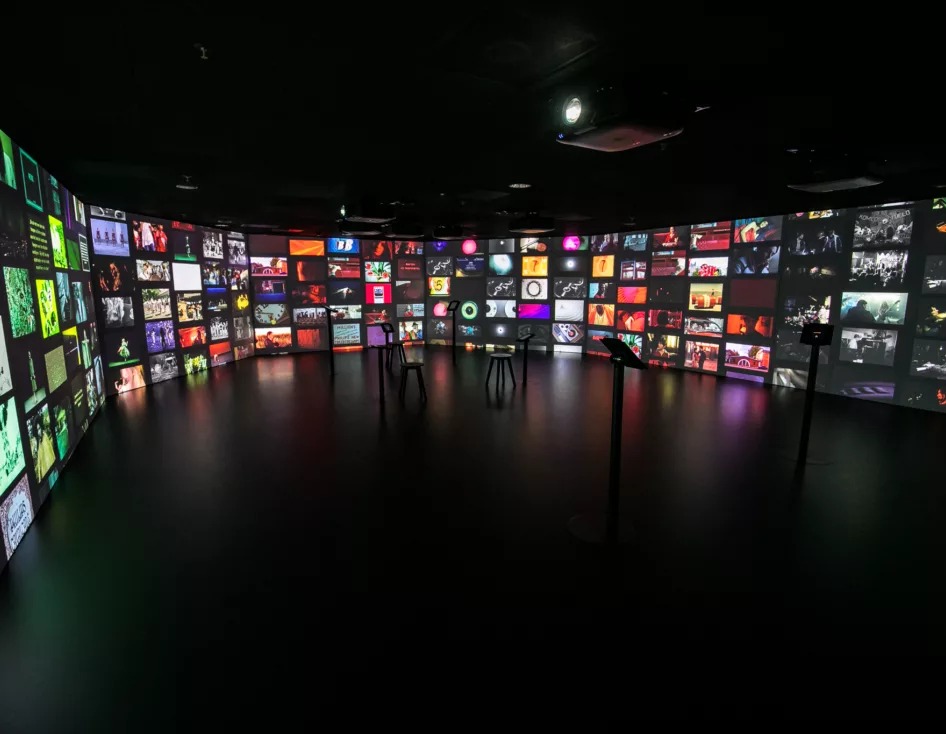
Taking this problem as its starting point, Archival Landscapes of AI approaches the audiovisual archive as both a user of AI, and a platform where reflection can take place and eco-critical awareness can be created. The project therefore aims to understand how AI can reconfigure and reactivate audiovisual archives in sustainable ways. To do so, the project uses AI to create data-enrichments around histories of extraction and environmental impact, specifically within the collection of Eye Film Museum and its immersive moving-image installation the Film Catcher, to create environmental awareness and reflection.
Over the past few months, the project has aimed to develop a more environmentally sustainable approach to creating data enrichments. This process involves understanding the needs, wishes and expectations of relevant stakeholders, namely artists, museum visitors, computer scientists, archivists and researchers. This resulted in the organization of a collaborative workshop at the Eye Collection Centre to think about AI technology, its environmental impact and its role in audiovisual archives.
Firstly, we were interested in user requirements regarding archival access. This entailed understanding the different categories that stakeholders relate to environmental impact, as well as the type of visual imagery they connect to this theme. Understanding these connections, helps inform the design of the data enrichments which in turn encourages accessibility and retrieval in the archive. Secondly, the project wanted to understand the user requirements regarding archival reuse, in particular the patterns and themes stakeholders identify and would like to explore in their appropriations of archival films. Lastly, we wished to understand how these data enrichments could encourage reflection around environmental impact within a longer history of resource extraction.
THE WORKSHOP
Morning presentations
The workshop day started with a presentation by the Archival Landscapes of AI team introducing project partners and aims for the day, followed by presentations reflecting the perspectives of different stakeholders and themes. From a research perspective, Marek Jancovic (VU) and Judith Keilbach (VU) presented on the materiality and environmental cost of media technologies. Their presentation explored the material resources and supply chains behind celluloid film and the often-invisible infrastructures of digital media, especially video streaming, critiquing the industry’s pursuit of endless growth. By foregrounding the materiality underlying analogue and digital audiovisual heritage, they reflected on the role of global corporations as well as the individual consumer, and how media consumption and preservation are entwined with more-than-human life.
Eva Stegmeijer, researcher at the Cultural Heritage Agency of the Netherlands, presented on the impact of climate change on cultural heritage and the difficult decisions this will require in the very near future. She provided concrete examples of cultural heritage endangered by heavy rain and wildfires. To this end, Stegmeijer has developed a ‘Serious Game’, where participants have to weigh ‘value’ and ‘costs’ against each other, creating awareness of the complexity of both concepts and the consequences that loss of cultural heritage will have on local communities and national identity. Her presentation expanded awareness from the environmental impact of cultural heritage, to the dangers these collections are in, and the difficult decisions that might be needed in the near future.
The last presentation of the morning was by visual artist Jurel Bakker, who presented her installation work at the intersection of ecology, art and technology. Her work centres environmental pollution, the more-than-human world and the role of technology. Discussing selected works such as the exhibition ‘Honderdtonners’ (2023), which explores the datafication of the Dutch dairy industry, and the collaborative work ‘Speculative Stepping Stones’ about the habitats of endangered lichen species, Bakker highlighted the entwinement of our industrial processes with local environments and impacts on more-than-human life.
Together, the presentations emphasised the many human and non-human actors involved in histories of extraction and environmental impact as well as the scale on which this process plays out.
Afternoon sessions
In the afternoon, participants were divided into two break-out rooms. Each group received a flip-over with markers, different coloured post-its, pens, pencils, glue, scissors and more. These supplies were organised with the intention of fostering creative, physical and collaborative work. In the first session, participants reflected upon concepts related to environmental impact and sustainability. Through this exercise, the project team aimed to broaden their understanding of the environmental associations of the stakeholders. Participants were asked to formulate as many concepts as they wished, and to think about overall categories and themes that connected the concepts. They were encouraged to think outside of the box and be as detailed as possible.
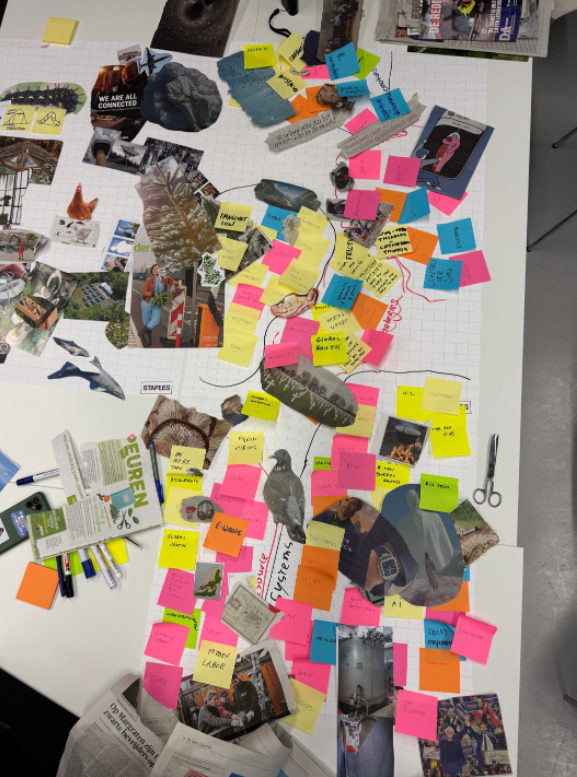
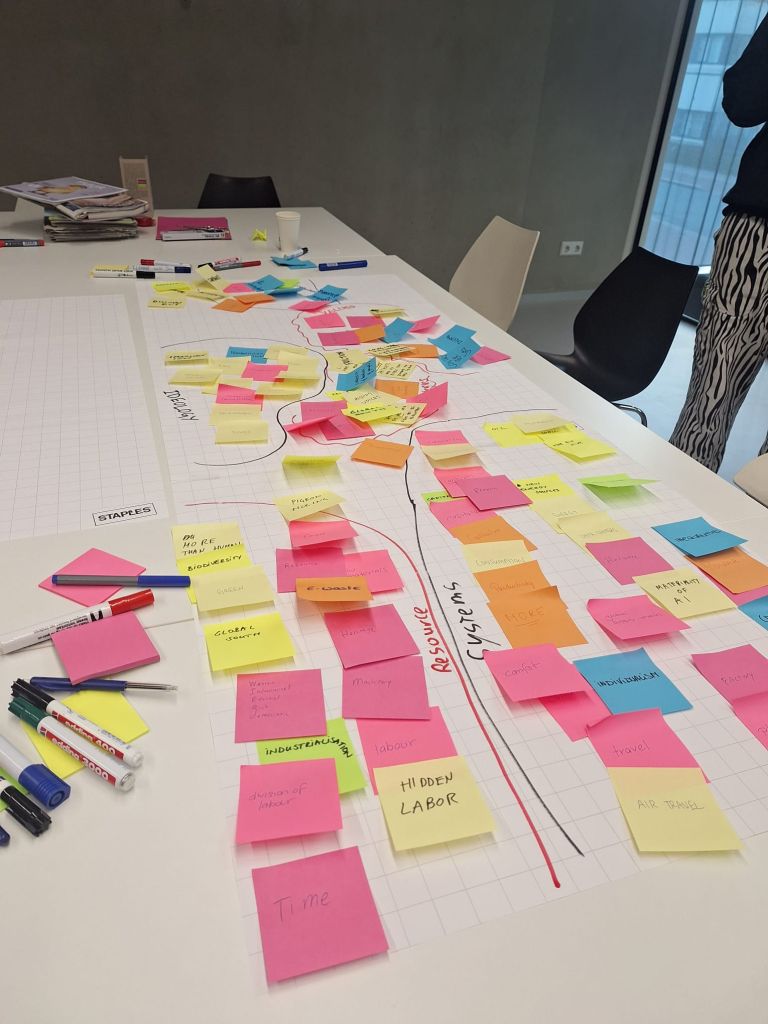
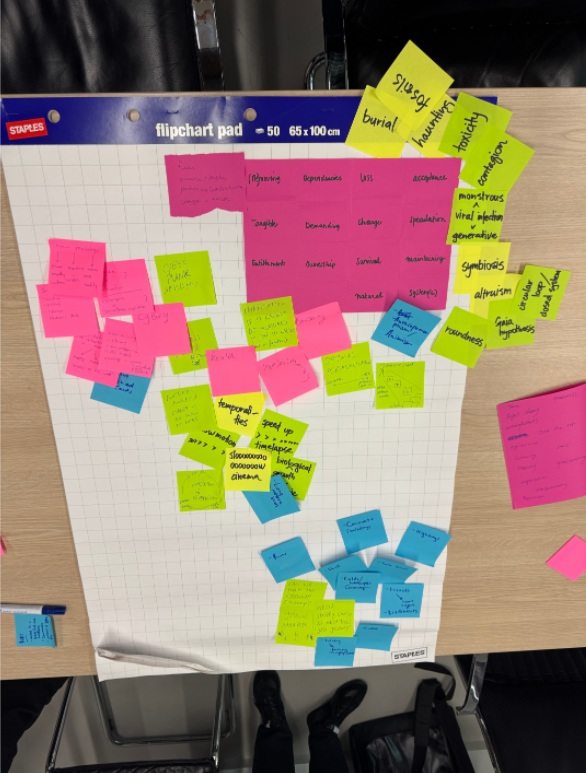
Both groups started with an individual rapid fire round, and wrote down as many concepts as they could think of on post-its, after which they discussed them collectively. Group 1 mentioned very concrete concepts (e.g. ‘more-than-human’, ‘power’, ‘Colonialism’ and ‘Green’). Group 2 wrote down tangible concepts such as ‘Gas’ and ‘Health’ but additionally mentioned concepts related to visual imagery and film (e.g. ‘landscape films’ and ‘long nature-shots’). The first group subsequently started to trace relationships between the different concepts, grouping them on paper and drawing labelled circles around them. They thought associatively, adding more concepts as they went along, addressing how post-its frequently belonged to multiple categories (e.g. e-waste relating to recycling as well as to colonialism and longevity’). Participants noted as many connections as they could make and concluded they “needed to negotiate” their definition. In this negotiation, participants explained their own understanding of the concepts, adjusting, adding and removing the post-its in front of them.
The second group dived further into the concepts they came up with, their definitions and their over- and misuse. They stated the importance of reflection upon the way models are trained, definitions are determined and visualisations are chosen. Cinema holds the potential to aestheticise, zooming in on insects and critters, or framing explosions or factories as beautiful, the so-called ‘anthropocene aesthetic’. Participants discussed the contextual dependency of concepts, such as how data extraction has been part of human nature since the industrial revolution. Knowledge is power and humans have always tried to maximize our knowledge, from encyclopedias to AI-models, from cultivation to extraction. Playing with these myriad of ways in which categories can be made, group 2 created a more associative map that avoided narratives, as this would allow for more free, metaphorical, montage-like connections, instead of didactic, closed or chronological categorisations.
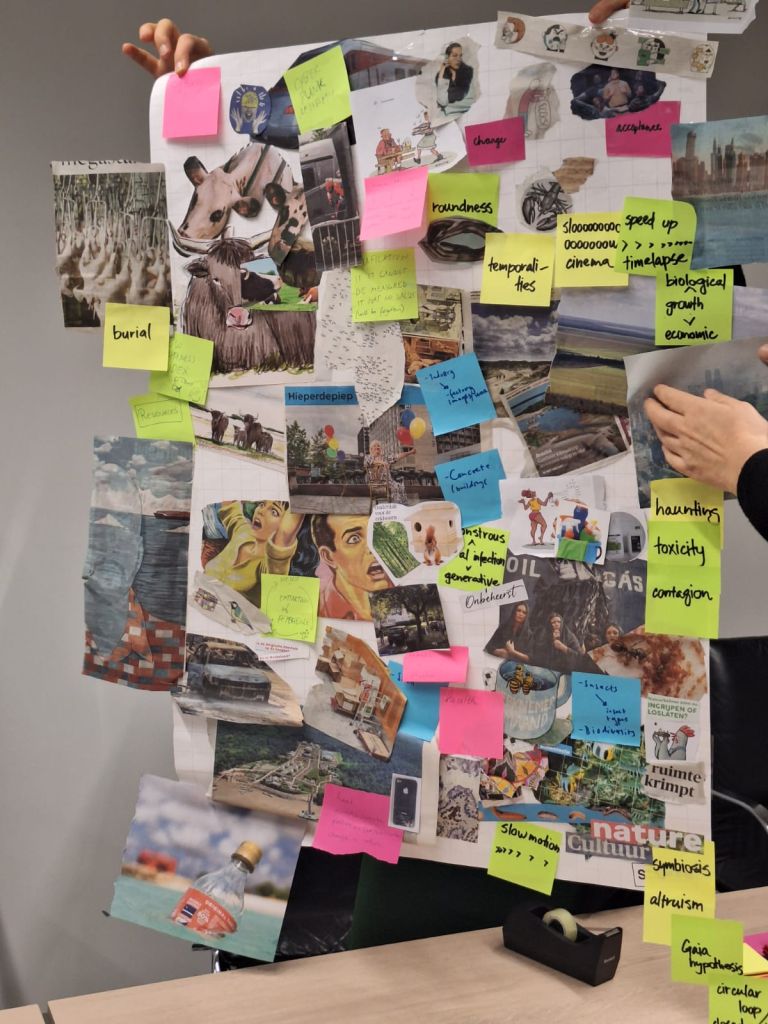
Figure 2: The results of group 1 (left) and group 2 (right) after the first session.
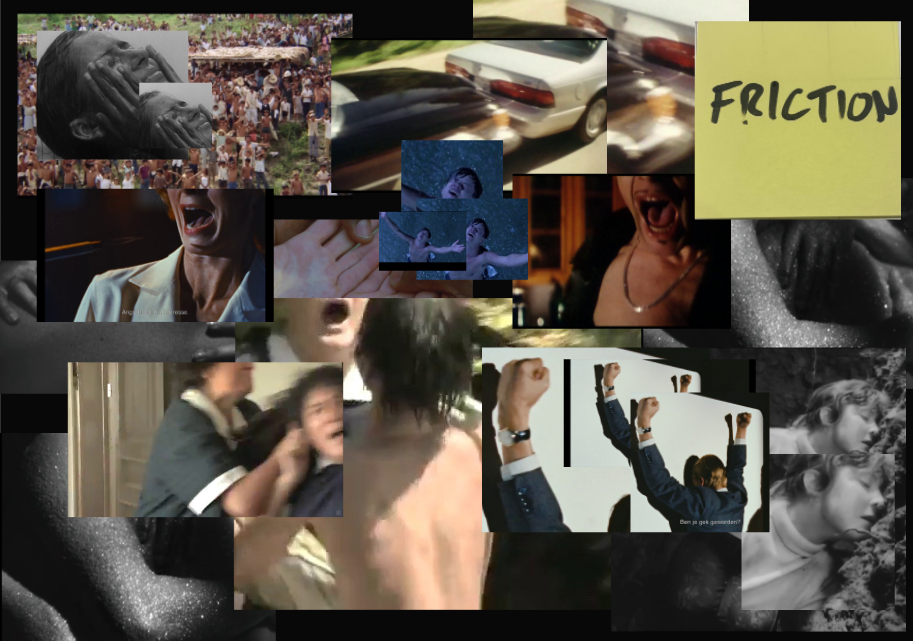
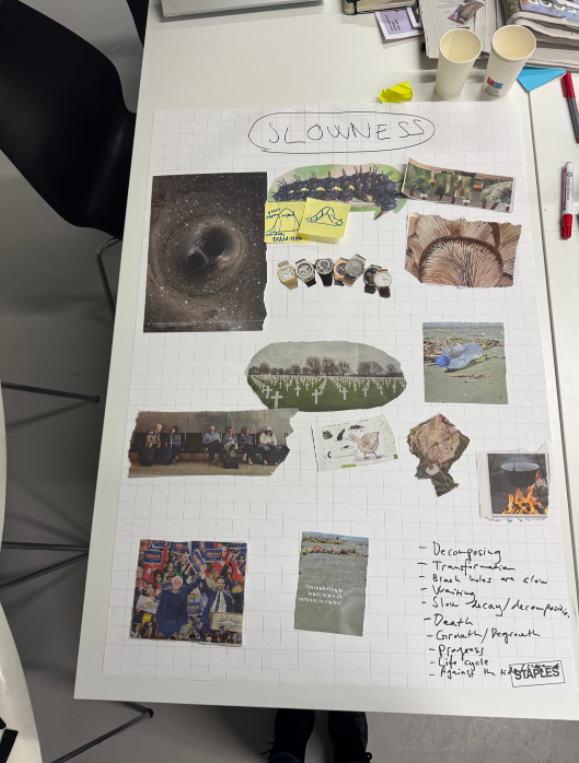
In the second session, the groups received the physical overviews of the other group and participants were asked to connect the received concepts and categories with their visual associations. Secondly, participants were asked to take these visual overviews and create larger narratives and themes. They were provided with several magazines and daily newspapers, and also had the possibility to work digitally with collected film stills using a Miro board. Group 1 decided to work physically, and group 2 used a combination of both.
Participants noted how different the overview they had received was from their own, the main difference being the approach to categorisation, with a participant stating the first group created more of an index, whereas group 2 created more associatively. All participants initially started their search individually, cutting out images they found interesting or saving them on their digital overview.
Group one notices how the magazines were fairly biased, centering around ‘green’ imaginaries. In the magazines and newspapers, they found images of ‘simulated nature’ (such as a box for birdsounds in the bathroom), but also more negatively connotated images such as traffic congestion, packages in sorting centres and plastic bottles in the sea, grouping them all to the post-its, moving them around and creating their own visual associations.
Again, visuals did not belong to just one concept or category. This was the problem with systematisation, they concluded, it was not ‘either-or’ but ‘and-and’, a challenge that will also be present in the categorisations for the data enrichments. The second group came to the same conclusion, as concepts and categories could be interpreted in multiple ways. They solved this issue by making a ‘visual vocabulary’. They kept the images and post-its together, but grouped them into different categories. This way, they could go into a more abstract and associative direction.
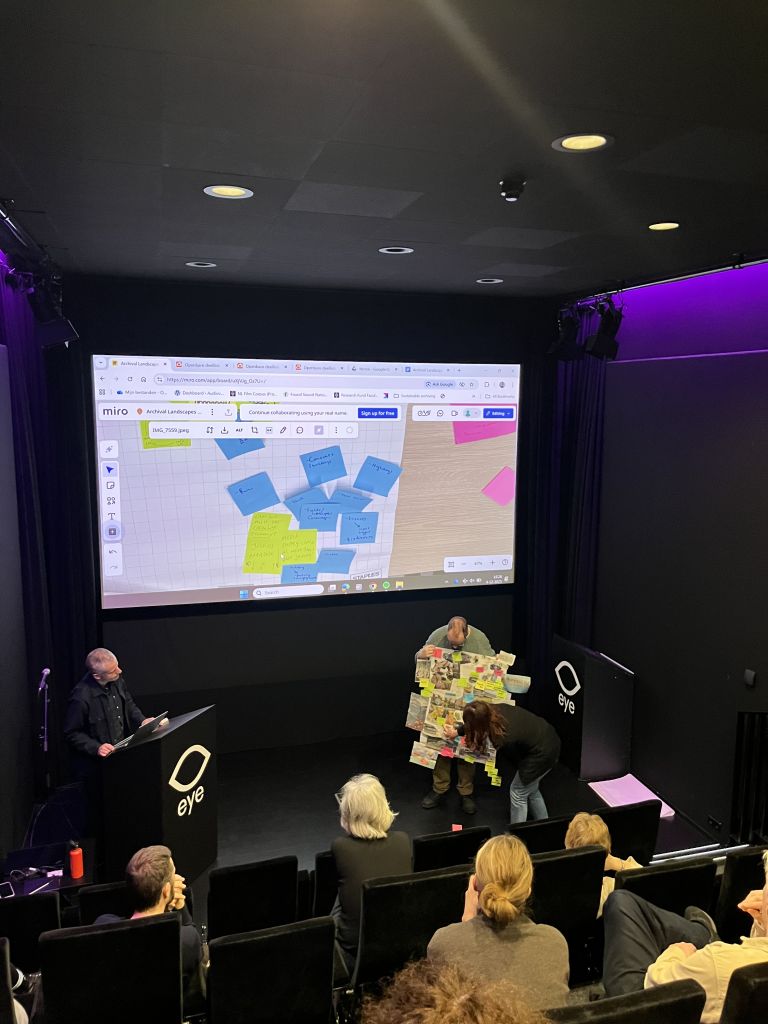
The afternoon ended with a plenary session where both groups presented their physical and digital overviews. They discussed the several ways in which cinema can visualise the concepts, as well as distinguishing features of the medium. Group 2 suggested there might be potential in linking abstract concepts with more tangible visuals to see if you can find new patterns and narratives. The first group mentioned how they had struggled with verbalising emotions and feelings, with one participant stating that this is also a narrative way to think, exploring the liminal spaces of our own experience and abstract concepts, instead of immediately categorising and therefore interpreting.
Lastly, the participants reflected on the digital process, with one participant browsing through the files in serendipitous fashion. A lot of the visualisations happened in a similar manner, where participants had instinctively chosen visuals to work with, and only afterwards found a post-it to match, reminding us how our minds will always find connections, patterns and narratives.
RESULTS
The Archival Landscapes of AI team aimed to understand the user requirements regarding archival access, creative reuse and environmental reflection. Both the list of concepts and categories, as well as the process with which participants listed them are valuable for the further development of the automatic data enrichments. Regarding archival access, the participants concluded that conceptualisation and categorisation are not straightforward, that connotations can differ depending on context and that there is duality to be found in most conceptualisations, from speed vs. slowness, activism vs. complacency and cultivation vs. extraction. Because of these findings, participants resisted fixed categorisation while at the same time recognising its necessity for navigation and order.
During the second session, the groups experimented with creative reuse. While they were instructed to find themes and patterns, the groups went beyond linear narratives and instead did so in a more associative and affective manner. The groups were aware of the limitations of the strict categorisation, and carried out more associative and montage-like practices. A common theme in the visualisations was the human vs. the more than human, as well as pristine nature versus destruction. Additionally, there were visualisations related to cinema’s medium specificity, focussing on temporal discontinuity (e.g. slowing down and speeding up), specific shot-types and cinema’s potential to make the ‘ugly’ beautiful.
Reflection regarding environmental destruction and histories of extraction took place throughout the day. The morning presentations emphasised the entwinement of the preservation and reuse of cultural heritage with histories of extraction, making both project members and participants reflect on their own contribution to the problem. AI’s potential to enable many strands of research was emphasised, while simultaneously critiquing its destructive consequences. The afternoon conversations repeatedly returned to systemic structures such as capitalism, colonialism and power. Participants frequently mentioned extraction, from natural resources to data extraction, all with very real material consequences.
While there was a strong presence of grief around environmental destruction, the groups had a hard time formulating affective states and reactions. The visualisations seemed to voice these emotions, allowing more room for abstraction and therefore anchoring the affective states while going beyond semantic descriptions. Lastly, there was a strong interest in decentring human narratives. Visualisations of animals, fungi and ecological metaphors allowed the participants to go beyond the human-centered, linear narrative. This emphasised the potential of cinema as a medium for creating reflection on environmental impact and histories of extraction.
FUTURE STEPS
The results from this workshop will be used in the following months to inform the further development of the data enrichments. It was emphasised that categories of every form, while necessary for proper retrieval, are inherently restrictive. Incorporating embodied enrichments such as camera angles in the project will leave more room for association and affective interaction with the collections.
In this development, it is important to remain aware of the decisions shaping the categories of metadata, as well as the source material with which the models are trained, as this will all shape future interpretation and therefore access and reuse. Additionally, the diversity of the participants highlighted a need for inclusivity of categorisation with attention to potential cultural differences and international backgrounds, specifically because of the deep affective experience of environmental destruction.
Additionally, a proof-of-concept will be developed, informed by the user requirements, to understand how the data enrichments can be implemented in artistic installations centred around histories extraction and environmental destruction.