
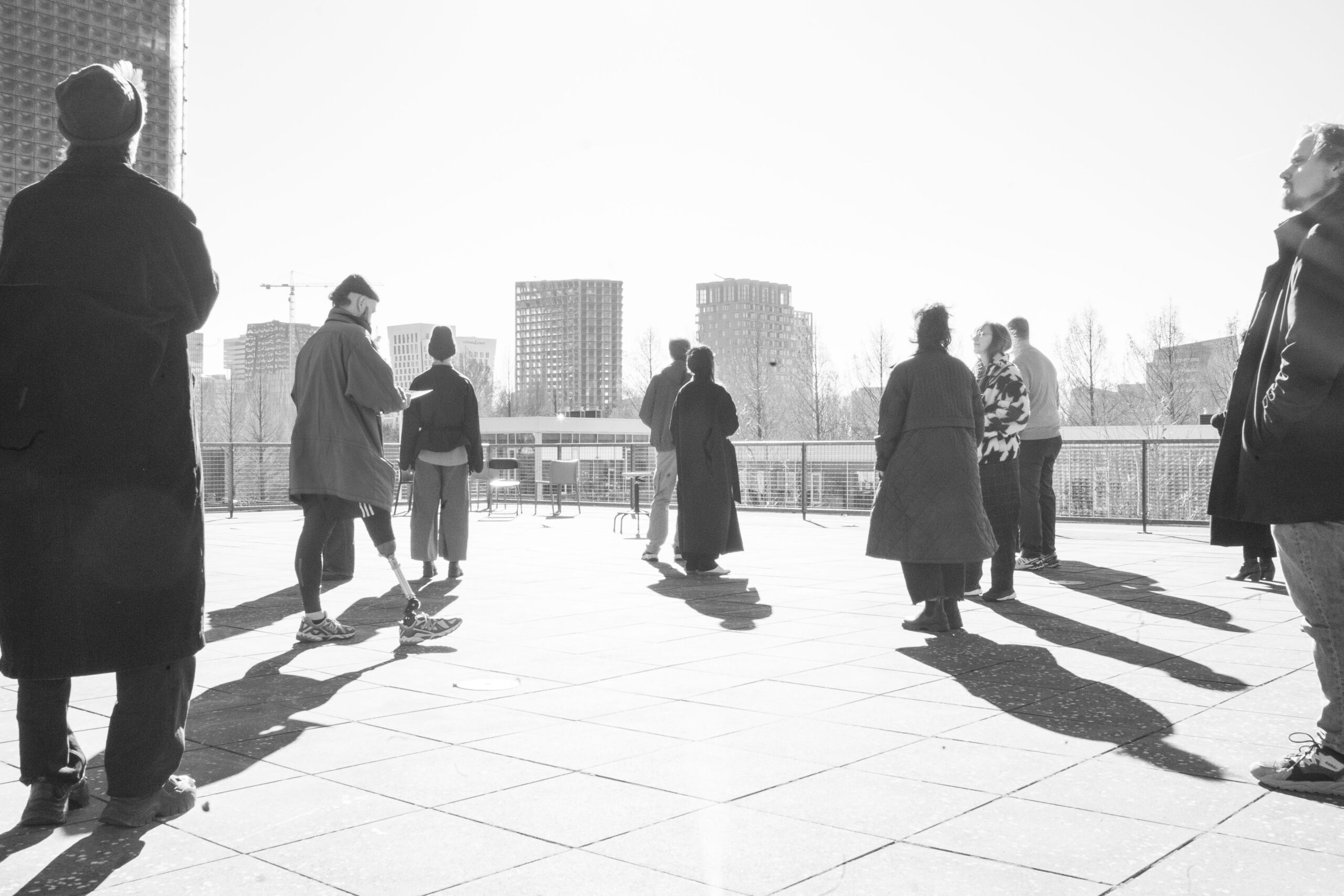

Slow AI material playground with Angelo Custodio, March 2025
Slow AI
Slow AI aims to foster a critical, ethical, and sustainable relationship with AI by reimagining how we engage with these technologies in our societies, helping us speculate alternative presents and futures with AI technologies.
Amsterdam University of Applied Sciences, Netherlands Institute for Sound and Vision.
Beyond reducing the speed of technological processes, “Slow AI” is a conceptual and practical approach that challenges the current ways our interactions with AI are scripted. Through artistic research, this two-year project will concentrate on how engaging with AI technologies from a material perspective can help us arrive at new ‘modes of engagement’ that resist notions of speed, efficiency and optimisation rooted in colonial and extractive histories. Helping us reimagine our relationship with AI technologies and how they are embedded in our societies. In this context, “Slow AI” can be seen as an anti-colonial movement, which, beyond just a temporal measure, represents a more ethical, critical, and sustainable relationship with the technology.
The two-year project will centre artistic research through “Material Playgrounds” to explore these new modes of engagement, incorporating concepts such as planetary health, kinship with non-humans, and deep listening. Researchers at the Amsterdam University of Applied Sciences collaborate with the Institute for Sound and Vision to investigate how these methods can address the biases and colonial histories present in AI technologies and cultural collections.
Visual Methodologies Collective
The Visual Methodologies Collective is a research group based at the Amsterdam University of Applied Sciences, specialising in visual, digital and participatory research for pressing social, cultural and environmental issues. Our team combines expertise from the humanities, design, and the arts, working together in transdisciplinary constellations with societal partners such as community groups, cultural organizations, and public institutions.
Projects includingsuch as Climate Imaginaries at Sea and Urban Belonging exemplify this approach by using co-creative mapping, artistic research, and data feminist visualisation strategies to foreground lived experience and imagine possible futures. Through these projects, the collective develops methods and tools that connect critical inquiry with everyday urban and ecological life.
Project Team
Sabine Niederer is Professor of Visual Methodologies and founder of the Visual Methodologies Collective at the Amsterdam University of Applied Sciences. She also co-coordinates the Digital Methods Initiative at the University of Amsterdam. Her work focuses on the cartography of public issues and online debates, using visual, digital, and participatory research methods, often with a focus on climate change.Sabine studied art history and new media & digital culture at Utrecht University and holds a Ph.D. in media studies from the University of Amsterdam. For more than two decades, she has curated and produced exhibitions, publications, and public programmes on digital culture. Together with Gabriele Colombo, she recently co-authored Visual Methods for Digital Research (Polity Press, 2024).
Mariana Fernández Mora is a researcher, writer and artist with a background in architecture. She works at the Visual Methodologies Collective (AUAS) and is the initiator of the Slow AI project, which explores decolonial, care-based approaches to artificial intelligence. In June 2025, she began her Professional Doctorate titled “Entangled Machines: Decolonial Modes of Encounter with Artificial Intelligence”. Her work investigates how technology shapes knowledge production with a focus on slowness, kinship and anti-colonial critique. Her 2022 publication, Dear Machines, an experimental thesis on co-writing with AI, is held in several institutional collections across Europe.
Inte Gloerich is a researcher at the Visual Methodologies Collective (AUAS). She is interested in the cultures and imaginaries around emerging media and technologies, and researches them from decolonial, feminist, and ecocritical perspectives. She received her PhD from Utrecht University in 2025 with a dissertation titled Reimagining the Truth Machine: Blockchain Imaginaries between the Rational and the More-than-Rational. Previously, she was a researcher and coördinator at the Institute of Network Cultures (AUAS), where she co-edited several publications, including State Machines: Reflections and Actions at the Edge of Digital Citizenship, Finance, and Art (2019) and Radical Care: Embracing Feminist Finance (2020).
Gwen Parry works as a researcher and research manager at the Visual Methodologies Collective and the Fashion Research and Technology research groups at the Amsterdam University of Applied Sciences (AUAS). She has a background as an art publisher and editor for, among others, the Stedelijk Museum Amsterdam, the Rijksmuseum, and BAK, basis voor actuele kunst. In addition to her work for the AUAS she is currently working on a book for Buro Stedelijk and as a monitoring committee member for the Dutch arts council (Raad voor Cultuur).
Rasa Bocyte is a cultural heritage professional with a passion for forging cross-sectoral collaborations underpinned by creative and critical approaches. As a Senior Advisor for Research Collaborations at the Netherlands Institute for Sound & Vision, she advocates for sustainable innovation practices that prioritise public values, slowness and care. She is one of the initiators of the Archival Images of AI programme and sits on the editorial board of the AI Media Observatory.
By cross-pollinating artistic and scientific research, the AI2– Artistic Inquiry x Artificial Intelligence consortium aims to provide holistic perspectives on AI technologies, that include human and more-than-human experience, ethical considerations, and planetary awareness towards more just futures.
This project in the research programme Innovation and Networks is (partly) financed by the Dutch Research Council (NWO) under the grants:
Archival Landscapes of AI (NWA.1418.24.008)
AI Greenhouse (NWA.1418.24.013)
Slow AI (NWA.1418.24.036)