
Alarm/Silence/Transformation: The Immortal Jellyfish as Non-Anthropocentric Guide through Crisis
Hosts:
Sara Pezzolesi and Inte Gloerich (Slow AI)
Date and Place:
09/06/2026 | 4Bid Gallery
This material playground started from a provocation: What if, instead of controlling the threats that surround us, we transformed ourselves in response? Artist and researcher Sara Pezzolesi introduced the immortal jellyfish as both a biologically wondrous creature and a conceptual compass. Unlike humans, who for centuries have met crises with extraction in service of domination—gathering data, predicting outcomes, optimizing systems—the jellyfish responds to threat by reshaping itself. Its lifecycle is not a struggle for dominance, but rather a flow of adaptation, never fixed or final. In a world saturated with crisis signals—from climate collapse to algorithmic bias—this material playground was an invitation to ask: What ways of knowing might offer an alternative to the logic of control?
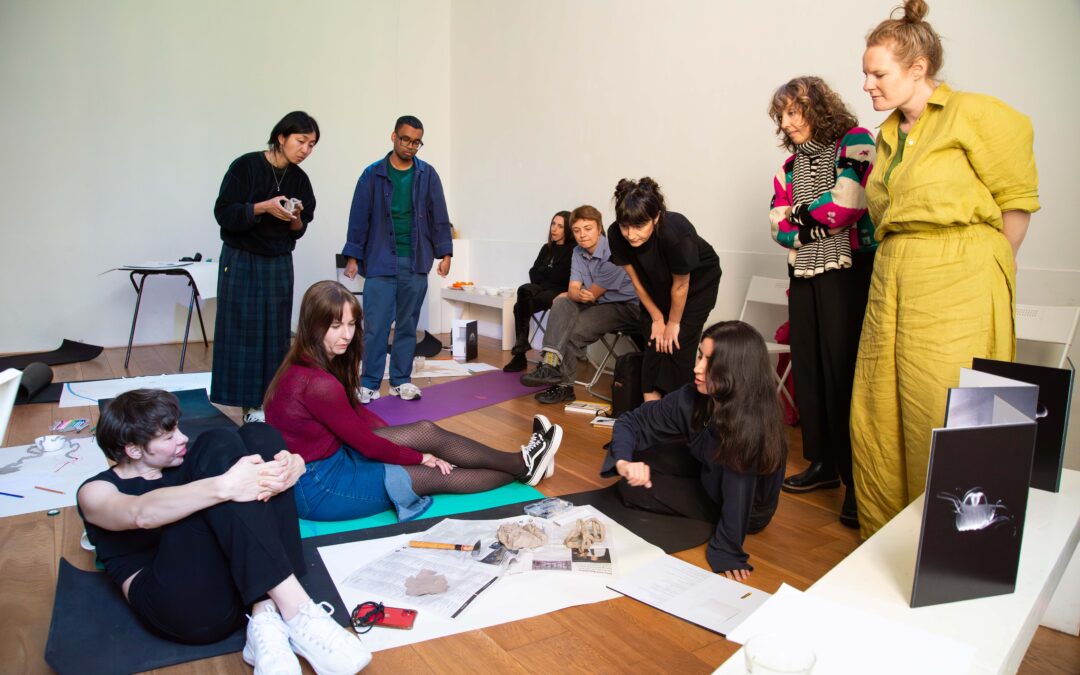
We started on the floor, eyes closed, immersed in Sara’s soundscapes that blurred the line between nature and artificiality. We heard sounds that evoked both the familiar and the uncanny. Then, in small groups, we engaged with Sara’s workshop books—poetic and olfactory prompts tied to natural elements like mud, air, ice, or lichen. The mud prompt, for example, spoke of stratification, of a material kind of memory that forgets nothing, of the smell of wet copper and melted plastic. On large sheets of paper, we annotated, drew, and let the prompts pull us into a space where we could try to sense alarm signals in different ways. A clay glacier melting onto a page, make-shift clay instruments carrying voices humming between harmony and dissonance. These were situated responses: embodied, imperfect, and alive.
While AI thrives on language, order, and control, on the extraction of data to predict and optimise, here, participants could engage different forms of knowing through the capacity of clay to mingle with its surroundings, the embodied experience of resonating sounds, and the feeling of being part of a collective hive-mind. As one participant put it, they experienced what it’s like to “to be territory” instead of to think it. To shape, transform, and interact with the world not through abstraction, but with hands and clay and in proximity to the bodies of others. The body, it felt, was not just a site of individual experience, but a bridge to connection and collective sense-making.
Another thread that tied participant’s reflection together was a sort of quiet rebellion against certainty. “Uncertainty is not the enemy.” And unanswerable questions came up, like “Do we experience the same winds as centuries ago?” One participant offered that “from the perspective of the glacier, the glaciers don’t need AI”, and perhaps this is a perspective that needs to be taken more seriously.
The workshop didn’t resolve the tensions between control and transformation, but it made them tangible. It put Slow AI into practice, with an emphasis on relationality, cyclical time, and perceptual ways of knowing.
Credits
Photography by Matija Stojanovic (https://www.instagram.com/matija.stoja/).