
Where do chatbots live?
Hosts:
Natalia Stanusch and Inte Gloerich (Slow AI)
Date and Place:
06/07/2026 | The Hmm
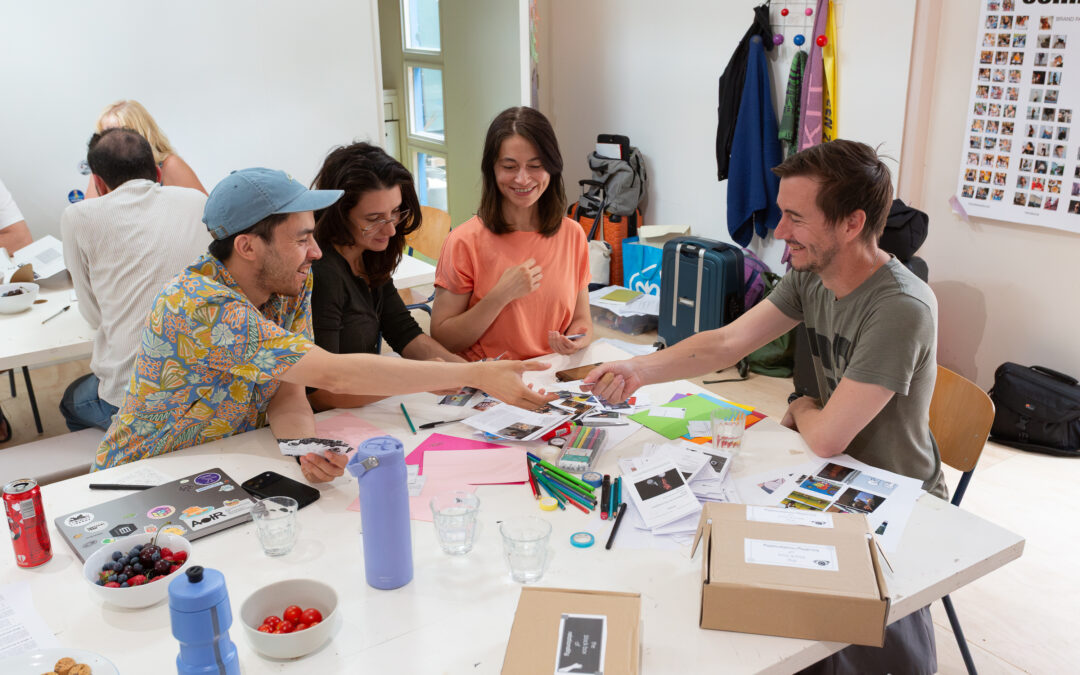
Where do chatbots live? was a material playground organized by Natalia Stanusch and Slow AI that set out to explore the material and relational dimensions of chatbots. While over time, imaginaries of locality have emerged around social media—such as the idea of Facebook "listening" to you—imaginaries of chatbots remain more diffuse and hard to pinpoint at the moment. Through analog meme-making, participants collectively interrogated the assumptions embedded in conversation-based AI systems, from health bots to assistants like Copilot and Meta AI, and co-created (counter)imaginaries to challenge their perceived opacity.
Participants formed small groups, with each group assigned a "black box" containing news clippings, images, meme formats, and guiding questions. These questions revolved around two lines of inquiry: locality/materiality—where chatbots "live" and the physical and imaginary infrastructures that sustain them—and relationality/subjectivity—how users conceptualise the a chatbot’s and their own role and agency, and the emotional dimensions that frame these interactions. The session culminated in a shared mapping exercise, where memes were clustered to reveal patterns, tensions, and emergent imaginaries.
The discussions uncovered multiple layers of materiality and locality that shape how we relate to chatbots. Participants reflected on the context of the prompt, often conveying particular emotions, such as frustrations arose around chatbots misunderstanding inputs, veering off-course, or making incorrect assumptions. Other layers were the interface, the infrastructure behind chat systems, and the knowledge logics that inform the responses they formulate. There were also reflections on the inevitability of AI, its omnipresence, and the unease it can evoke when it feels too close or assumes a role akin to a friend. Some participants stressed the value of human interaction versus chatbot engagement, while others critiqued the economic dynamics replacing human labor with automation.
A central, underlying question informed the material playground: Does our understanding of a chatbot’s materiality change how—or if—we engage with it? For some, knowing the "where" might alter their comfort in sharing. For others, the opacity of these systems can reinforce a sense of powerlessness, underscoring the need for counterimaginaries: alternative ways to relate to and understand chatbots, or the development of alternative systems that align with critical, ethical, and sustainable values. The workshop didn’t resolve these tensions but clarified the demand for a more critical engagement with chatbots’ material and relational dimensions.
Credits
Photography by Lucía del Valle Ramírez (https://www.instagram.com/luciadelvalleramire.z/).